

Updates
home / News
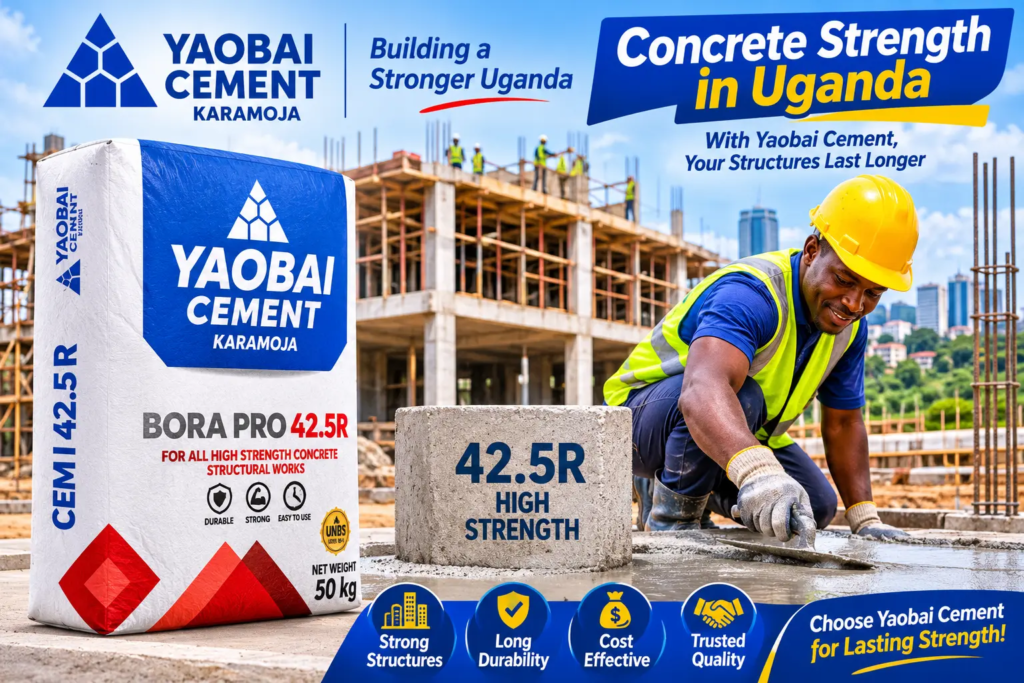
Understanding Concrete Strength Beyond Cement Quality
Introduction
When discussing construction quality, one of the most common assumptions is that stronger cement automatically produces stronger concrete.
Although cement is a fundamental component of concrete, the final strength and durability of concrete depend on several interconnected factors.
The quality of aggregates, quantity of mixing water, proportioning of materials, mixing procedures, compaction and curing all influence the performance of the finished concrete.
For builders, contractors, engineers and property developers in Uganda, understanding these factors is essential for producing concrete that meets the technical requirements of a construction project.
The Role of Cement in Concrete Strength
Cement acts as the binding material that holds aggregates together after mixing with water.
During hydration, cement reacts with water and gradually develops the binding properties responsible for concrete strength.
Different cement types and strength classes are manufactured to meet different technical requirements.
Yaobai Cement provides a range of cement products for the construction market, including OPC 42.5R, CEM II 32.5R, CEM IV 32.5N and Bora 22.5.
The appropriate cement should be selected according to the required application, applicable standards and approved project specifications.
However, even suitable cement cannot compensate for poor concrete production practices.
The Water-Cement Ratio
One of the most important factors affecting concrete strength is the water-cement ratio.
This refers to the amount of mixing water used in relation to the mass of cement in a concrete mix.
Adding excessive water may make concrete easier to work with, but it can increase porosity and reduce the strength of hardened concrete.
Conversely, insufficient water can make concrete difficult to mix, place and compact properly.
The correct water-cement ratio must therefore be established through an appropriate mix design that considers the required strength, workability, exposure conditions and materials being used.
For construction supervisors, controlling water addition is an important quality-control responsibility.
The Importance of Quality Aggregates
Aggregates make up a substantial proportion of concrete.
Their characteristics directly influence the quality and performance of the finished material.
Important considerations include:
- Aggregate grading and particle-size distribution.
- Cleanliness and absence of harmful impurities.
- Aggregate strength and durability.
- Appropriate proportions of fine and coarse aggregates.
- Moisture content before mixing.
Using unsuitable or contaminated aggregates can compromise concrete performance even when the cement itself meets the required specifications.
Contractors should ensure that aggregates are inspected and approved before being incorporated into concrete production.
Proper Mixing and Material Proportioning
Consistency in concrete production is essential, particularly on projects involving foundations, columns, beams, suspended slabs and reinforced concrete structures.
Materials should be measured accurately rather than relying on inconsistent estimation.
Mechanical mixing, where appropriate, helps achieve a more uniform distribution of cement, water and aggregates.
The mixing process should produce concrete with consistent workability and uniform composition.
For larger construction projects, approved concrete mix designs and documented quality-control procedures should be followed.
Why Concrete Compaction Matters
After concrete is placed, proper compaction is necessary to remove entrapped air and ensure that concrete fills the required spaces around reinforcement and within formwork.
Poor compaction may result in:
- Honeycombing.
- Voids within concrete.
- Weak sections.
- Poor surface finishes.
- Reduced durability.
Appropriate vibration equipment and competent workmanship are therefore important, particularly when placing reinforced concrete.
Care should also be taken to avoid over-vibration or segregation.
Concrete Curing: An Often Overlooked Construction Practice
Concrete does not achieve its intended strength immediately after placement.
It develops strength through the hydration process, which requires suitable moisture and temperature conditions.
Curing helps maintain the conditions necessary for continued hydration.
Common curing practices include:
- Keeping exposed concrete surfaces adequately moist.
- Using suitable wet coverings.
- Applying approved curing compounds.
- Protecting newly placed concrete against rapid moisture loss.
The curing method and duration should comply with the project specifications and applicable engineering standards.
In Uganda, where construction sites may experience high temperatures and direct sunlight, proper curing deserves particular attention.
Quality Control Throughout Concrete Production
Achieving consistent concrete quality requires attention at every stage, from material procurement to final placement.
Construction companies should consider implementing:
- Inspection and approval of cement and aggregates.
- Verification of approved mix designs.
- Accurate measurement of materials.
- Controlled water addition.
- Proper mixing and compaction.
- Appropriate curing procedures.
- Concrete sampling and strength testing where specified.
These measures help identify potential problems early and improve confidence in the finished construction.
Yaobai Cement and Mega Pak Uganda Limited
Reliable construction begins with appropriate materials and sound engineering practices.
Mega Pak Uganda Limited is an official distributor of Yaobai Cement in Uganda, supporting the country’s construction industry with access to a range of cement products.
Available products include:
OPC 42.5R: A cement strength class commonly considered for applications requiring higher early and specified strength performance, subject to product specifications.
CEM II 32.5R: A cement category used in construction applications according to its technical characteristics and approved mix requirements.
CEM IV 32.5N: A cement category with a normal early-strength classification, suitable for applications consistent with its certified specifications.
Bora 22.5: A cement product category whose suitability should be established against its declared specifications and intended application.
Mega Pak serves contractors, developers, hardware dealers and other customers seeking Yaobai Cement in Uganda.
Conclusion: Quality Concrete Is a Combination of the Right Materials and Good Workmanship
Concrete strength is not determined by cement alone.
The interaction between cement, water, aggregates, mixing, compaction and curing ultimately determines the quality of the finished concrete.
For Uganda’s growing construction industry, understanding these fundamentals can help improve construction practices and support better project outcomes.
Mega Pak Uganda Limited continues to support the sector as an official Yaobai Cement distributor, providing access to different cement products for construction requirements.